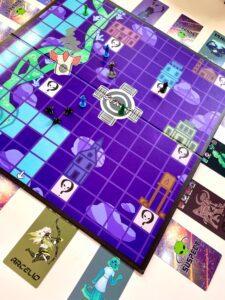
GaIM students at NSCM transformed classroom game design projects into two officially published tabletop games, earning industry recognition while gaining hands-on experience.
By: Majdulina Hamed | Published March 9, 2026
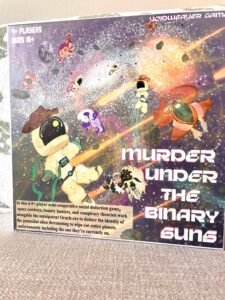
Photo of the board game, Murder Under the Binary Suns.
For a team of students at the Nicholson School of Communication and Media, a class project didn’t end at the final presentation; it became a published product.
In the Fall 2025 semester, students in Instructor Madeline Davis’ Game Design transformed two collaborative tabletop concepts into officially published board games, Crumbs and Curses and Murder Under the Binary Suns. What began as coursework evolved into a professional venture spanning design, art direction, publishing and marketing.
“Each project presented students with unique challenges and themes, allowing students to design tabletop games that help them learn key fundamentals of game design,” Davis says.
A Fast-Paced Fairy Tale with a Twist
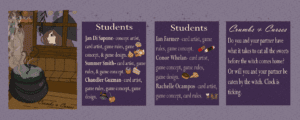
The team consists of Jan Di Sapone, Rachelle Ocampos, Summer Smith, Conor Whelan, Ian Farmer and Chandler Guzman, who first published Crumbs and Curses, a quick, high-energy memory card game inspired by “Grimms’ Fairy Tales”.
“We enjoy the fictional folklore created by the Grimm brothers,” says Conor Whelan, a digital media game design major and the 2D and 3D artist for the team. “We took the most inspiration from Hansel and Gretel, two kids who find a house made of candy that a witch lives inside of.”
Designed to be playable in under three minutes, the game challenges players to match colorful dessert cards while avoiding witches, all without verbally communicating with their partner.
“We were inspired to create a simple game that anyone of all ages could enjoy,” says Jan Di Sapone, a digital media major and game producer, production manager, creative writer, art director and lead designer. “We wanted to put a twist on a memory game by adding witches to create pressure and adding treats that people’s brains could easily recognize for better memory training.”
Each member illustrated at least two cards, intentionally highlighting the variation in artistic styles. “Each card shows off the artist’s drawing style,” Sapone says. “The variation in styles and texturing highlights each person’s unique approach.”
The team’s efforts were rewarded with a Red Accolade Award on The Game Crafter for strong sales performance, a milestone none of them anticipated.
“It was surprising since it was the first time any game that I had worked on won an award,” says Chandler Guzman, a digital media game design track major and computer science minor. “I felt and still feel very proud of our team and the hard work everyone, especially Jan Di as our publishing lead, put into all of our games.”
Sapone echoed that sentiment. “The Red Accolade gives me great pride and drive to create more things that people will enjoy,” she says. “It is a great honor to know that people enjoy something I have created.”
Building a Strategy-Heavy Space Western
After the success of Crumbs and Curses, the team raised the stakes with Murder Under the Binary Suns, a narrative-driven social deduction game that blends science fiction and western themes.
Inspired by film media such as Justified, Westworld and Star Wars, the game assigns players roles including space cowboy, bounty hunter, conspiracy theorist and the Oracle, a neutral game master who guides the experience. Players investigate one of sixteen possible alien suspects while navigating hidden motives and deception.
“As someone who grew up playing social deduction games such as Werewolf and Town of Salem, I wanted to create something with a similar asymmetrical player dynamic,” Guzman says. “Although the game is cooperative at heart, the separation into factions creates a sense of tribalism that encourages players to compete to find the truth.”
Guzman also says that the mechanics were influenced by games such as Outfoxed!, Alien: Fate of the Nostromo and Among Us, blending movement systems, morale mechanics and voting discussions into a cohesive experience.
“Our goal was to create a strategy-heavy, deduction-based game that forces players to pay close attention to tone, demeanor and body language,” he says.
The students express that the project required weeks of playtesting and refinement to ensure every clue logically narrowed to a single suspect.
Collaboration Beyond the Classroom
As roles evolved naturally throughout development, Guzman ultimately served as project manager and lead game designer, overseeing documentation, mechanics and player sheets while Sapone led marketing and publishing through her independent label, Voidweaver Games.
“As the person who usually delegated tasks, I went with what I felt they would enjoy most and what I knew they were able to do,” Guzman says. “Everyone was involved in creating the rules, design and overall theme.”
Artists Sapone, Ocampos and Smith focused on 2D design elements, including boards, cards and character art, while Farmer and Whelan contributed to 3D modeling, printing and painting.
Sapone also handled the business side independently, from formatting and pricing to marketing materials and convention tabling.
“Seeing what needed to be done motivated me to work harder,” she says. “I found a lot of enjoyment in figuring out how much it truly takes to publish a board game.” That hands-on experience extended beyond development. “The best thing I could take away was my socialization skills when I tabled at a convention and learned how to pitch my games properly,” Sapone says. “I spoke to people from different backgrounds and learned how to garner interest. That is a very strong skill to have.”
Davis says this type of real-world engagement exemplifies why collaborative creative projects matter.
“Students in this program are making amazing projects, and they should be shared outside of the classroom,” she says.
For Guzman, the experience solidified his career path.
“Game design has always appealed to me—it’s one of my special interests,” he says. “Through this class and this experience, I became a better game designer and solidified my choice to be a gameplay programmer. I finally feel like I’ve found a role that fits me perfectly.”
The team credits Davis’ mentorship for helping them navigate the publishing process.
“It was because of her guidance that we were able to navigate publishing our games,” Guzman says. “She helped build my confidence in my skills and my future as a game developer.”
As Sapone continues developing additional collaborative and solo projects slated for release later this year, the impact of this first publication remains meaningful.
“The most fulfilling part was when someone told me that a card or character I created was their favorite,” she says. “It filled me with so much joy.”
From fairy tale-inspired card play to immersive space western storytelling, these GaIM students are demonstrating how creativity, collaboration and professional ambition can turn classroom concepts into published success.