A Nicholson School of Communication and Media student blends personal history, documentary filmmaking and scientific storytelling to illuminate an untold story with global reach.
By: Majdulina Hamed | Published May 5, 2026
For Nicholson School of Communication and Media (NSCM) graduate student Mario Villavicencio, storytelling has been shaped by reinvention, cultural memory and a commitment to bringing overlooked stories to light.
That perspective recently earned him the People’s Choice Award in the Knights in Focus Video Competition, recognizing his short-form video highlighting a documentary project in development as part of his master’s research.
The competition invites graduate students to step in front of the camera and communicate how their academic work and experiences at UCF are shaping the future. Through short and compelling videos, students can highlight their research or creative projects, reflect on their graduate journey, and demonstrate the value of graduate education at UCF.
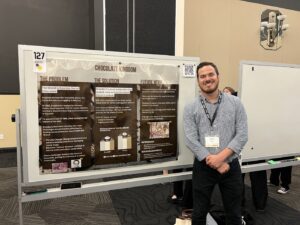
His award-winning video offered a glimpse into a larger project centered on the CCN-51 variety of cocoa, a high-yielding hybrid developed in Ecuador that has significantly influenced global cacao production and the chocolate industry.
For Villavicencio, that impact is both personal and historical.
“I first heard about the plant scientist who developed this cocoa variety when I was a child,” he says. “He developed it in a small town where my grandparents are from, so in many ways, this project is also a tribute to my family’s history.”
The documentary explores the legacy of an often-overlooked scientific pioneer while examining Ecuador’s close relationship with cocoa through time.
“I’ve always been drawn to stories that highlight overlooked individuals,” he says. “This one shines a light on someone whose contributions have largely been forgotten.”
In just 60 seconds, however, conveying a complex documentary project for the competition required a different kind of storytelling.
“How do you reduce a feature documentary to a 60-second film?” he says. “I approached it as a short trailer.”
Rather than trying to summarize the project in full, he focused on sparking curiosity through concise, visually engaging storytelling. An approach he said helped translate a nuanced subject into short-form content.
“With such a limited timeframe, the goal was not to overwhelm the audience with too much information,” he says. “It was to draw people in and make them want to learn more.”
That strategy resonated with the judges, awarding him the People’s Choice distinction and affirming that the project is connecting with audiences.
“Personally, it’s incredibly rewarding to see that hard work pays off,” he says. “Professionally, it’s encouraging to see my work starting to reach people.”
Beyond the recognition, Villavicencio said participating in the competition gave him a broader appreciation for the graduate research community at UCF.
“It was inspiring to see the range of work being done across different programs,” he says. “It reminds me we are part of a larger community of people all working toward meaningful projects.”
Originally from Guayaquil, Ecuador, Villavicencio earned a degree in international business from Universidad Santa María Campus Guayaquil and worked as a consultant before his path changed directions.
“About 10 years ago, I made a major shift from a business background into film,” he says. “I took a leap of faith and fully committed to storytelling.”
That decision ultimately led him from Ecuador to the United States, where he earned a Bachelor of Arts in Film from the University of Tampa, gained professional experience in post-production in Los Angeles, and later returned to Ecuador before enrolling at UCF to pursue a master’s degree focused on the development of a feature-length documentary
He shares that in an industry driven by convenience and speed, the origins of everyday products often remain invisible. Chocolate, is no exception as its journey from cacao pod to finished bar is rarely considered by those who consume it
“We consume chocolate quickly and often without thinking about the long and complex process behind it, or the many people involved in bringing it to life,” he says. “My hope is that this documentary helps audiences better understand that journey and recognize how cacao supports countless lives around the world”
As he continues developing the feature documentary, Villavicencio says he is grateful for the opportunity to highlight the work being done within UCF’s master’s feature documentary track and is eager to share the completed film with a broader audience.
“It feels like affirmation that I’m on the right path,” he says, “and it strengthens my resolve to keep going, knowing this is a story that needs to be told.”