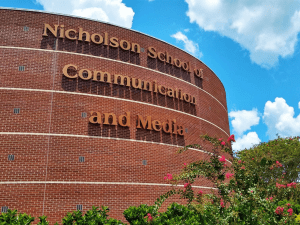
Nicholson School of Communication and Media professors share what makes their teaching methods unique.
By: Majdulina Hamed | Published December 8, 2025
At the Nicholson School of Communication and Media, creativity is more than a concept; it’s a teaching philosophy embraced by faculty who are redefining what learning looks like in the classroom today.
This semester, three NSCM faculty members, Professor Dr. Robert Littlefield, Associate Instructor Katie Coronado, and Technical Design Director and Associate Lecturer Ron Weaver, demonstrated how creative instructional methods can transform complex concepts into memorable learning experiences that strengthen students’ confidence, collaboration, and real-world readiness.
Turning APA Style Into a Game: Dr. Littlefield’s APA World Games

Graduate students in Dr. Littlefield’s course, Risk and Crisis Seminar, expected to review APA formatting, but few anticipated doing so through a high-energy, team-based competition. Inspired by students’ desire for active engagement, he designed the APA World Games, a 10-round challenge where teams work to identify and correct APA errors embedded in writing samples. As students raced to submit the most accurate revisions, the classroom transformed into a lively arena of collaboration, problem-solving, and academic skill-building.
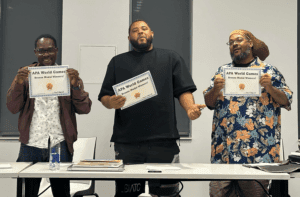
“Students want to be actively engaged and demonstrate what they know,” Littlefield says. “The APA World Games gave them a chance to apply their learning in real time, and their response proved me right.”
Graduate students reflect on how this activity reshaped their understanding of APA and strengthened their confidence as scholars and instructors.
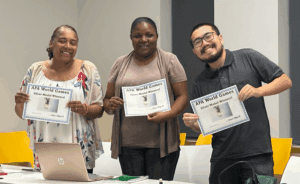
Strategic Communication PhD student Kylee Seaver shares that the competition refreshed her knowledge of APA guidelines.
“It was fun, fast-paced, and engaging. It reminded me how easy small errors are to miss and how important it is to double-check my work,” she says.
Seaver says that this creative teaching has had an impact that has encouraged her to use similar teaching styles.
“This activity actually inspired me to create my own SPC 1608 Olympics to help my students review some course material for the end of the semester,” she says. “I’m excited to see if my students enjoy an activity like this.”
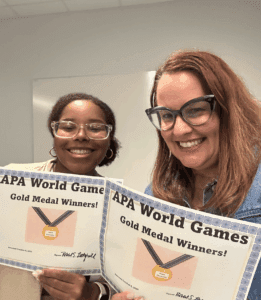
Fellow Strategic Communication PhD student Jennifer Cook agreed that her understanding of APA has much improved.
“Seeing APA in print instead of on a screen was eye-opening. Now, when I’m writing, I actually remember some of these rules because I missed them during the game,” Cook says.
For Strategic Communication PhD student Guilherme Hiray Leal, the activity elevated APA from an academic requirement to an achievement.
“The sense of competition made it more memorable. I can still remember specific mistakes I made and that helps me correct them in my papers today,” he says.
In comparison to traditional ways of teaching, Hiray Leal says this unique experience stood out to him
“An activity like this one makes the content feel more memorable and engaging. The sense of competition makes us care more about the content at the moment, but it shows us that these are things we should care about in our academic careers. Making mastering APA an achievement makes things more rewarding when we are working on our papers and we successfully apply APA in them.”
Littlefield says this is precisely the impact he hoped for, especially as he observes students increasingly gravitating toward visual, hands-on learning methods.
In the Newsroom: Katie Coronado Integrates High Impact Professional Experiences

Coronado brings more than two decades of experience in professional journalism, production, and communication into her teaching at NSCM. Drawing from her work with NBC, Telemundo, PBS, and leadership roles at UCF, Coronado transforms her classroom into an active, fast-paced newsroom where students transition from passive listeners to real-world content creators.
Her commitment to excellence and industry relevance recently earned her the 2025 Florida Association of Broadcast Journalists’ Inaugural Teacher of the Year Award, underscoring her influential role in shaping future media professionals.
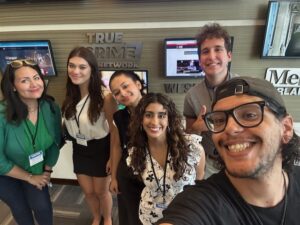
“Students learn best when academic rigor intersects with industry practice,” Coronado says. “Creativity is important, but so are ethics, standards, and professional workflows. My goal is to merge both.”
Coronado’s courses are built on immersive, hands-on learning. This semester, she incorporated experiences that mirror professional newsroom environments:
- A behind-the-scenes visit to WESH-TV, where students observed live production and engaged with journalists.
- Guest lectures from industry leaders including Chloe Nelson, Jay Edwards, José Cancela, Madison Little, Bridgette Snedeker, Chris Pinson, and international free speech expert Orlando Luis Pardo Lazo.
- A mock press conference with the Brazilian Film Festival, where students practiced questioning, performance, and on-camera communication.
- Full podcast production in NSCM’s studio, guiding students through scripting, recording, editing, and performance coaching to produce an industry-ready portfolio piece.
Through these experiences, students learn to structure stories, adapt to shifting workflows, troubleshoot under pressure, and collaborate in real time, which are essential skills for modern communicators.
“In multimedia production, students must troubleshoot, collaborate, problem-solve, and adapt,” Coronado says. “Those challenges build the resilience required in today’s communication fields.”
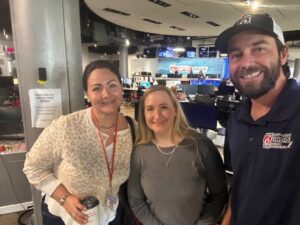
Students describe Coronado’s courses as transformative, citing both professional growth and personal confidence as key outcomes.
Junior broadcast journalism student Bryan Gonzalez shared that the newsroom-style structure fundamentally reshaped how he understands journalism.
“Participating in these activities helped me apply journalism skills in real-world settings. From pitching stories to working under deadlines and leadership structures, the class felt like working in an actual newsroom,” Gonzalez says. “It taught me how to collaborate, how to ask for help, and how to support others; skills I’ll use long after college.”
He emphasizes that Coronado’s student-centered approach created an environment where peers learned from one another, developed strong professional relationships, and explored the realities of newsroom life beyond traditional lecture formats.
“This class didn’t just prepare me academically; it prepared me professionally,” he says.
Senior film and media production student Kiersten Blaylock echoes the significance of hands-on learning:
“Participating in practical projects helped me understand the equipment and build meaningful portfolio pieces,” she says. “It was more engaging than traditional lectures because we were working on things we were genuinely passionate about.”
Blaylock notes that the podcasting experience equipped her with technical skills and confidence that she believed will carry into her future media career.
“I feel like I got more from this class than I usually would have. These are skills I’ll use long-term,” says Blaylock.
Additionally, senior broadcast/electric journalism student, Kiara Velez shares that Coronado’s hands-on teaching style made the realities of professional reporting come to life.
For Velez, what made this class stand out was how it prepared her for the unexpected realities of working in media through experience.
“This project was entirely hands-on. We had to overcome technical audio challenges and the pressure of interviewing external sources,” she says. “It felt real and immersive; it was great to just jump in and work independently to produce a show.”
The experience also strengthened her confidence as an emerging journalist.
“It significantly boosted my confidence in solving problems quickly under pressure,” she says. “I got so much practice while anchoring the news and collaborating with reporters. It also reinforced the ethical responsibility journalists have when covering vulnerable community needs.”
Together, these students’ experiences illustrate how Coronado’s approach helps students build confidence, develop technical mastery, and cultivate the mindset of working journalists before they ever step into their first newsroom job.
Improvisation as Instruction: Ron Weaver’s Creative Classroom at FIEA

At FIEA, Weaver uses an entirely different but equally impactful approach of improvisation. Drawing from improvisational training at SAK Comedy Lab and Brenda Harger at Carnegie Mellon’s Entertainment Technology Center, Weaver integrates improv techniques into courses on storytelling and game development to build skills which extend far beyond the classroom.
“Creative teaching methods transform long class sessions into memorable moments,” Weaver says. “Improvisation encourages flexibility, problem-solving, and the ability to recover gracefully from mistakes.”
One of his most celebrated activities is the long-form improv exploration of the Hero’s Journey, where each stage of the journey is expressed as a distinct scene, and the students embody every character, inventing plot points on the spot.
Instead of learning the model through slides, students embody the characters, make spontaneous decisions, and collectively build stories in real time. The result is an unforgettable lesson in structure, collaboration, and creative risk-taking.
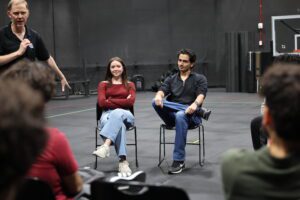
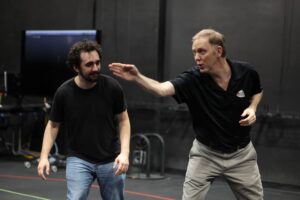
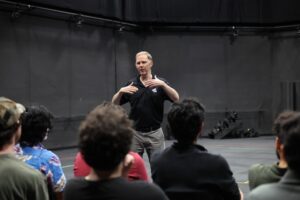
Interactive Entertainment graduate student Courtney McCracken notes that improv helped him lift up teammates’ ideas during collaborative projects and better understand the foundations of creative teamwork.
“Collaborating in creative spaces can be really, really difficult and exploring established foundations in a field all about creative collaborating was a great way to get students into that mindset,” says McCracken. “Team dynamics in game development is a piece of the subject that can get super overlooked, and through improv we were introduced to these concepts in an engaging and team-building method.”
He emphasizes that the activity made narrative structure “click” in a way lectures alone could not.
“Aside from turning the place into comedy central and getting people more engaged in the subject matter, it’s also just nice to get up and move around while learning. It’s another way to get people engaged and tuned in,” says McCracken. “It’s also significantly more social than a traditional lecture—which is another thing that keeps students engaged in the material.”
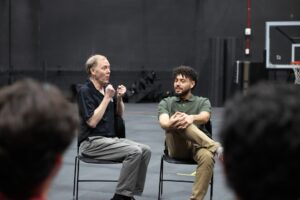
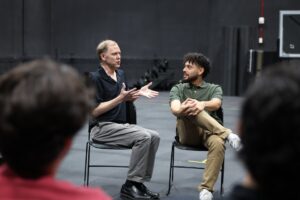
Graduate student and artist studying Animation, TJ Shwedo, shared that the improv course served as both an instructional tool and a meaningful reset during the intensity of FIEA coursework.
“Improv is a game of cooperation and interaction, a microcosm of the games industry itself. Working with classmates of different experience levels taught me how to adapt and collaborate. We didn’t just learn concepts, we practiced them immediately, whether acting out the Hero’s Journey or building scenes together,” says Shwedo
Shwedo also emphasizes the emotional and professional value of Weaver’s approach:
“Improv class was always a welcome break from the stress of FIEA,” says Shwedo. “It taught us how to say yes to ideas, navigate chaos, and bring everyone’s contributions together; skills that directly translate to real industry teamwork.”
Weaver believes these outcomes are central to communication and media education today, where students must learn to engage audiences, collaborate effectively, and adapt quickly in a fast-paced digital environment.
At NSCM, creativity isn’t just a skill; it’s a transformative learning experience that equips students to thrive in real-world communication, media, and industry environments. The creative teaching practices of Littlefield, Weaver, and Coronado reflect NSCM’s commitment to hands-on, innovative learning experiences that prepare students to excel academically and professionally. Whether through competition, improvisation, immersive storytelling, or newsroom-style classrooms, their methods demonstrate that meaningful learning happens when students are challenged, supported, and inspired.