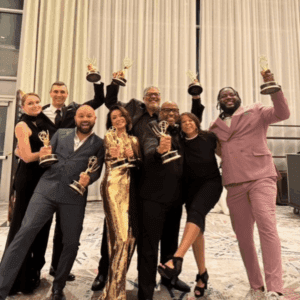
An award-winning collaborative project led by NSCM faculty and alumni, showcased the power of interdisciplinary storytelling and community engagement.
By: Majdulina Hamed | Published March 2, 2026
A collaborative project involving faculty and alumni from the University of Central Florida has received award winning recognition for their extended trailer of One Way: Move in Hope’s Direction from the Suncoast Regional Emmy Awards, highlighting the impact of long-form, community-centered storytelling.
Jason Gregory, executive producer of the project and Lecturer for the Department of English in the College of Arts and Humanities, reflects with gratitude on what this milestone means to him.
“This recognition affirmed the trust the community placed in us and the care the team put into their work,” he says. “These awards belong to the people whose stories are at the heart of the film and to a team that committed to telling those stories responsibly over time.”
Rooted in Orlando’s historic Parramore community, the extended trailer follows returning citizens, mentors, families, and community leaders navigating reentry, accountability, and restoration, while centering on individuals working to create opportunities and stability within their community.
“I was thrilled to hear the news that our extended trailer had been nominated for five categories,” says Dr. Erica Rodriguez Kight, writer and producer for the project and associate lecturer at the Nicholson School of Communication and Media (NSCM). “Being Emmy-nominated was enough for me to be beyond happy and feel like we got our message across effectively through that short piece.”
Kight shares that while the documentary’s message and the people at its center mattered most to her, she was deeply grateful for the recognition.
“Winning four out of those five nominations was beyond my wildest expectations. Seeing three of the men featured in our project also earn Emmys was the most rewarding part, because they deserved it more than any of us,” she says.
Gregory says Mona Moayer ’16 served as the director and brought in her production company RedFour Productions, to produce the documentary. Along with her media experience, she spent the past 6 years building rapport with the locals in Parramore to ensure the story was told authentically.
“This project is the result of long-term collaboration and commitment,” Gregory says. “Mona’s sustained relationship with the community shaped the film’s trust, perspective, and integrity.”
Kight emphasizes how each team member’s unique expertise strengthened the project’s depth and impact.
“Our NSCM alumna and director Mona Moayer has a knack for finding the right people to build a team. We each bring unique perspectives, skills and talent to the table — but most importantly, we are committed to getting this right and doing this story justice.”
In addition to Gregory, Kight and Moayer, UCF film alumnus Aaron Hosé ’21 contributed production and editorial expertise. Hosé currently serves as media production manager and lead producer for the UCF Center for Distributed Learning video team, helping enhance the film’s visual storytelling and post-production quality.
Both Gregory and Kight hope the documentary resonates deeply with audiences and challenges common misconceptions. Gregory explains that the film encourages viewers to see individuals beyond stereotypes while fostering awareness of communities that are often overlooked. Kight echoes this sentiment, noting that the story’s impact extends far beyond Orlando.
“I recently showed the extended trailer to my media production capstone class, and a student was moved to tears after watching it because she said it reminded her of her hometown and her community,” Kight says. “Seeing her reaction made me realize that even though this story is about Parramore, it is about people and communities all over the nation. If just one person feels seen or heard after watching this film, we will have done our jobs as storytellers.”
Gregory hopes the recognition inspires future collaborative projects and demonstrates the possibilities that emerge from long-term storytelling initiatives. Similarly, Kight believes the recognition serves as encouragement for students and alumni to pursue meaningful, service-oriented creative work.
Looking ahead, the team is continuing to work on the full 90-minute feature-length documentary, which will include expanded storytelling, post-production refinement, and distribution planning.
“The trailer marked an important milestone, but the full film deepens the story and fulfills the commitment made to the community,” Gregory says.
Kight shares she is also preparing for future collaborative projects inspired by the documentary. She will be working on a National Endowment for the Arts grant-funded media arts initiative alongside NSCM Instructor Rick Brunson and the City of Orlando’s Peace Orlando program, which focuses on community violence intervention and prevention. The project will feature creative works such as music videos, podcast episodes, and a digital memorial produced by Parramore residents.
Both Gregory and Kight emphasize that meaningful storytelling requires patience, trust, and accountability. Gregory encourages aspiring storytellers to commit fully to their subjects and craft, while Kight stresses the importance of building genuine relationships with the individuals whose stories are being shared.
“We are not here to take people’s stories and exploit them for views, clicks or accolades,” Kight says. “We are here to serve and provide a platform for the voices of people who want to be heard.”
For more information about the One Way project, visit https://oneway.film/